
Initiation as Real Passage
Chapter from my current WIP, "The Living Tree"

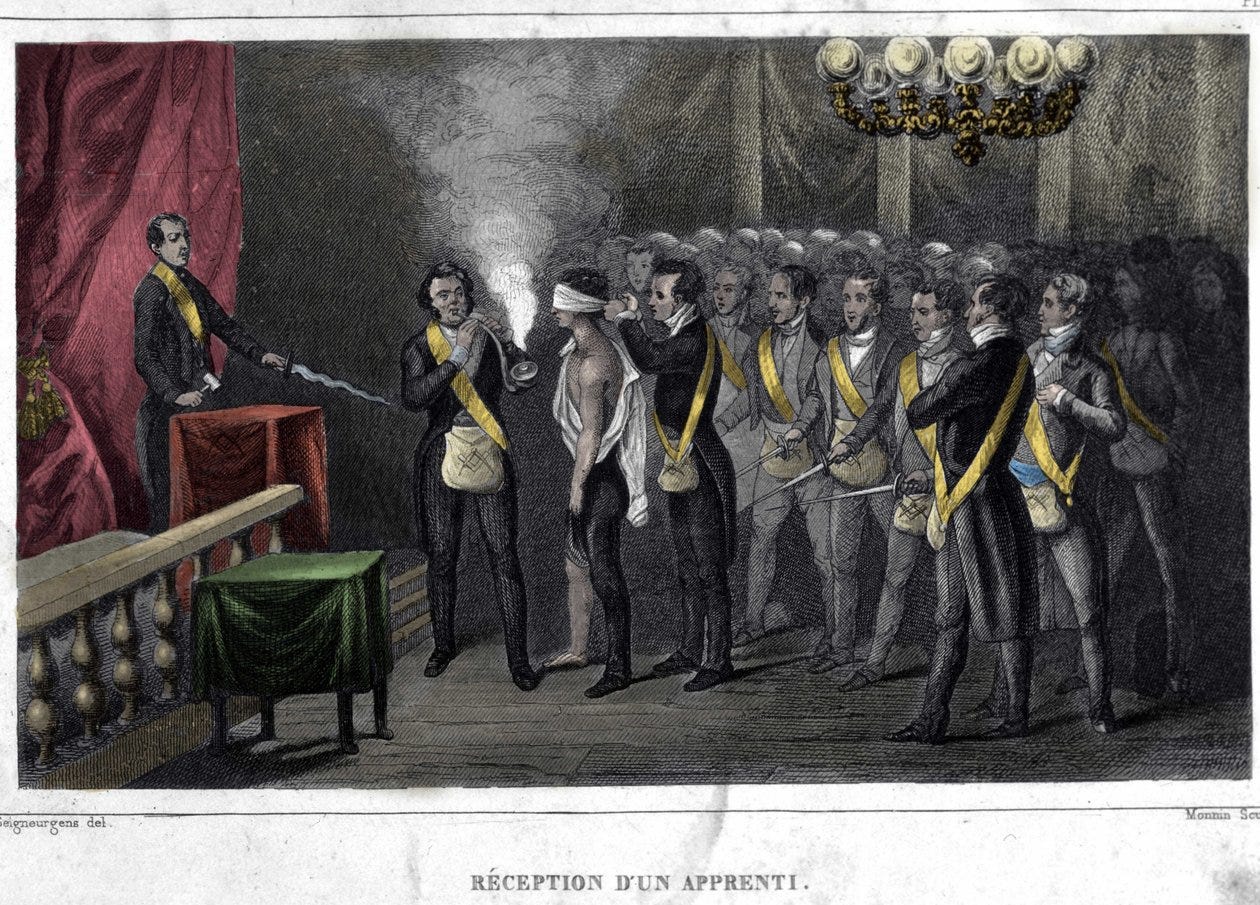
The word “initiation” has been flattened by modernity into near-meaninglessness. It conjures induction ceremonies, new-member handshakes, the rituals of fraternal lodges. At its worst, it suggests hazing: an arbitrary trial that marks social belonging but changes nothing real. Even in ostensibly esoteric circles the word often conceals a vacancy. A person enters a room, words are spoken, a grip is exchanged, and nothing ontological has occurred. The individual leaves with the same consciousness, wearing a new title. At the opposite pole, therapeutic culture has recast every difficult transition as “initiatory”: a divorce, a career change, a bad psychedelic trip. The metaphor flatters, but it dissolves the term into mere personal growth, stripping away the precise metaphysical content that made initiation worth the word in the first place. If everything that changes you is initiation, then initiation is nothing in particular. Both reductions have to be refused.
Initiation, in the sense this architecture demands, is something else entirely: a real passage of consciousness through ordered strata of being, enacted within a disciplined framework and carrying lasting consequences for the structure of the soul. It is an ontological event — a phrase that needs grounding in something firmer than rhetorical emphasis. To say that initiation is ontological means that the structure of participation changes. The soul does not merely learn something new; it is joined to a level of reality to which it was previously closed, or from which it had been functionally disconnected. The Latin root initiare — to grant access, to make a new beginning — already carries this implication. The Western mystery tradition has always understood authentic initiation as a transition from one way of being to another: the transcending of ordinary consciousness into a more or less permanent anchoring in a higher reality. In the Lesser Mysteries this is spoken of as rebirth into spiritual life; in the Greater Mysteries, as rebirth in the Light of absolute being, a radical change of state. The gate opens to the prepared, not the merely curious. What passes through it is the person, reconstituted at a deeper register of selfhood.
The transmission involved is no mere symbol in the weak sense of the word. A high initiate projects a specific psychic state — the impulse for transmutation — into the consciousness of the candidate, and that projection takes hold only if the candidate’s preparation has been adequate. Where preparation is insufficient, the intended operation either fails or, worse, catalyzes disintegration in the natural unity of the human being’s principles. The language here is clinical rather than dramatic: this is a precise spiritual procedure whose failure mode is harm, not embarrassment. Moral integrity, genuine desire for self-transcendence, and the “subtle and emotional vibrations” that proceed from a life lived in uprightness are not moralistic prerequisites imposed from outside; they are the material conditions without which the transmitted force cannot be received, as an unprepared retort cannot hold the alchemical fire.
The ceremony itself deploys texts, symbols, and ritual movements to lead consciousness from the world of sensory perception toward higher levels, a process amplified by the initiators’ breathing, visualization, projection, and vibration of sacred words. The initiate becomes connected to a theurgical chain, a living current of transmitted power that links every member to the tradition’s invisible sources. But the transformation of the profane into an initiate begins even when the initiate can barely register its effects on thought and action, because the initial shift is largely unconscious. Only through subsequent and regular ritual work does the initiate gradually become aware of the transformative events, testing them in everyday life and consciously integrating them into the psyche. A lifelong acceleration of spiritual evolution follows, and it registers concretely — in how the person perceives, wills, and relates to the Real.
The logic of transmission in a Christian key
What warrants speaking of this kind of operation within a Christian worldview? The warrant is not institutional. Sacramental theology need not “approve” initiatory praxis, as though the magisterium were the gatekeeper of all spiritual reality. The warrant is structural: the logic of transmission already inhabits Christianity at its core, and has done so from the beginning.
The early Church was itself an initiatory body, and it knew this explicitly. Catechumens — those preparing for baptism — were not casually welcomed. They underwent years of instruction, fasting, and moral scrutiny before the community judged them ready for the sacramental rites. They were excluded from the Eucharistic celebration: after the liturgy of the Word, which they could hear only from the narthex, they were dismissed. Only at the Easter Vigil, after completing their preparatory course, were they baptized in white garments and received into the mystical body of Christ. Baptism, chrismation, and first Eucharist formed a single initiatory sequence, conferring not simply membership in a social body but a new ontological status: incorporation into Christ, participation in His death and resurrection, the indwelling of the Holy Spirit. The early Fathers did not regard this as metaphor. It was metochē, real participation, and the sacramental rites were the means of its transmission. Cyril of Jerusalem’s mystagogical catecheses, delivered to the newly baptized in the days after their initiation, disclose the disciplina arcani — the discipline of the secret — whereby the deepest meaning of the sacraments was revealed only after they had been experienced. The logic is identical to that of the mystery schools: understanding follows participation rather than preceding it. The rite itself effects the change; explanation comes after, to stabilize and deepen what has already occurred at the level of being.
The ordination of priests and bishops preserved this initiatory character even as the baptismal catechumenate was progressively flattened. In ordination the Holy Spirit is called down through the laying on of hands, conferring sacramental authority on the ordained person and linking that person to an unbroken chain of power reaching back to the apostles. This is spiritual transmission through physical contact, enacted in ritual context, not organizational delegation — and it produces a permanent ontological change that the Western tradition names a “character,” an indelible mark on the soul. The ordained person stands in a living chain through which power flows from its divine source, across centuries, through embodied persons.
Pseudo-Dionysius the Areopagite recognized all of this as theurgy. Writing around the turn of the sixth century, deeply shaped by the Neoplatonism of Proclus, Dionysius described the Christian sacraments in his Ecclesiastical Hierarchy as theurgic mysteries and named Christ as the archē and ousia of every theurgy — the origin and essence of all divine working. This identification is not superficial. For Iamblichus, the Neoplatonist who gave theurgy its most rigorous philosophical articulation, theurgic rites were not a human response to the call of the divine but the divine call itself, manifesting in sacred rites. The merging of the soul with the divine is caused exclusively by the divine; the actions of the soul can only be receptive or preparatory. When Dionysius transposes this framework into the Eucharist, into baptism, into the entire hierarchical order of the Church’s worship, he is saying that Christian sacraments operate on exactly this principle: God acts; the human being receives and cooperates. The rite is a divine operation descending through consecrated form, not a human technique imposed on passive matter.
The implications for understanding initiatory praxis within a Christian context are direct. When an initiatory order within the Western mystery tradition works with texts, symbols, projections, and the vibration of sacred names to transmit a genuine change in the soul’s participation, it is operating within the same logic the Church has always applied to its own sacraments. The Ogdoadic tradition’s self-understanding as a current within the Christian mysteries is best read as a recognition that sacramental and theurgic operation share the same deep grammar — matter bears spirit, symbol participates in the reality it signifies, the divine initiative descends through consecrated channels to effect what human effort alone cannot — rather than as an extrinsic claim bolted onto pagan technique.
None of this collapses the distinction between ecclesial sacraments and initiatory ritual. The forms differ; the institutional contexts differ; the theological warrants differ in important ways. But the operative principle is the same, and recognizing it allows the Christian initiate to understand what is happening in the initiatory ceremony without recourse to arbitrary or purely psychological explanation. Something is transmitted because transmission is how divine power moves through embodied reality. The chain is real because the cosmos is structured for participation, and participation is enacted — not merely thought about — through consecrated action.
Iamblichus insisted that the embodied soul, once incarnated, can no longer return to the divine on its own power, intellectually or otherwise, and stands in need of redemption through the invocation of God. The idea that the soul can ascend to the One by its own strength reflects, he argued, the habit of thinking with material self-interest and inadmissibly translating it into a spiritual context. The structure of that claim anticipates the Christian doctrine of grace: the creature cannot, by its own resources, restore a relation that only the Creator can give. Iamblichus argues it on metaphysical grounds two centuries before Augustine argues it against Pelagius on soteriological ones, and the convergence is striking even though the two men would have parsed the word “God” very differently. The initiate does not seize the higher state by force of will or cleverness of technique; the initiate prepares, purifies, and opens, and divine power descends to accomplish what the human being alone cannot.
Stabilization as the criterion of real passage
If initiation is real, it must show. But what counts as evidence here? Not fireworks, not ecstasy, not visions or supernatural phenomena, though these may occur. The proof of authentic passage is soberer and more demanding than any of that: a re-ordering of will and perception, and of the soul’s capacity for sustained engagement with the Real, that endures and deepens over time.
The Ogdoadic tradition is explicit on this point. Initiation into each degree ignites a degree-specific inner fire within the initiate, a process mirrored in the alchemical stages of the Great Work. In the first degree, corresponding to Nigredo, the fire is slow and mild, purifying the earthly nature, harmonizing the four elements. In the second degree, corresponding to Albedo, a further purification of the psyche occurs: an opening to the soul’s nature, originally free from worldly impressions and social conditioning, through the hard work of confronting behavioral patterns and psychological imprints. In the third degree the fire intensifies toward Rubedo — mystical union with the spirit. But the tradition adds a crucial qualification: profession in the third degree is not fully achieved through initiation alone. Fulfillment can come only through subsequent personal effort and reception from higher levels. The ritual opens the gate; the initiate must walk through it, and keep walking.
This graduated structure prevents the inflation that plagues esoteric culture, where a single peak experience or a single ceremony is mistaken for completed transformation. Real passage takes time. The fire, once ignited, continues to burn until the process is complete, but the combustion is gradual, sometimes imperceptible in its day-to-day progress. What changes is not primarily the content of experience — what the initiate sees or feels — but the mode of experience: how perception is organized, what the will reaches toward, which registers of reality have become accessible to sustained awareness.
This is where the Martinist inheritance, treated at length in earlier portions of this work, stops being background and becomes the measure. Louis-Claude de Saint-Martin’s account of interior reintegration provides a standard by which operative claims can be judged. In Of Errors and Truth he described reintegration as a painstaking return of the human being to right relationship with the divine Principle from which disordered will had separated it — slow restorative labor rather than a spectacular event. The fall, in his reading, was a voluntary deviation rather than a cosmic accident: the misuse of liberty by a being endowed with the capacity for the divine Good who instead pursued partial and disordered goods. Restoration cannot be superficial, because the damage is not. It reaches to the roots of will and intellection. The reintegrated person is not the old self with new ideas but a reconstituted agent whose faculties have been progressively re-ordered toward their proper objects.
Here, then, is the standard. If an initiatory passage has been real, the evidence will be found not in visions reported but in a life: in how the will orders itself, in how clearly the person now perceives the sacred, in whether the capacity for sustained communion with the divine has deepened. The initiate whose will remains as scattered after the ceremony as before, whose perception of the sacred remains as intermittent, whose moral life shows no progressive alignment with the virtues — this person has undergone a ceremony, not an initiation. The fire was offered but did not take, or it took and was extinguished by neglect.
Martínez de Pasqually’s legacy presses the same point from the opposite direction. His seriousness about the ontological rupture at the heart of the human condition — the fall as genuine damage to being rather than a myth to be psychologized — means that ascent cannot be treated as self-improvement. If the fall is ontological, the repair must be ontological. If the human being is genuinely separated from a level of reality to which it originally belonged, then restoration requires real reconnection, not merely a shift in attitude or belief. Pasqually’s theurgic operations in the Ordre des Élus Coëns were designed to accomplish exactly this: to invoke the divine powers capable of repairing what human effort alone could not, and to do so through disciplined ritual action within a framework of moral purification and spiritual preparation.
The convergence of Saint-Martin and Pasqually on this point — the interior philosopher and the operative theurgist — gives us a dual criterion. From Saint-Martin: has the will been reintegrated? Has the person begun to think, perceive, and desire from a center that is no longer the disordered ego but the divine image restored? From Pasqually: has that rupture been addressed at the level where it occurred? Has the initiate been reconnected — not merely encouraged — to the stratum of being from which the fallen condition had severed participation? Where both criteria are met, the passage is real. Where neither is met, the ceremony was empty form. Where one is met without the other — interior reorientation without operative reconnection, or operative contact without moral and intellectual re-ordering — the work remains incomplete: a half-lit fire requiring either more fuel or more air.
The proof is always in the life that follows. The initiate tests newly gained insights and behavioral changes in everyday life and then consciously integrates them into the psyche. The temple is not an escape from the world but a laboratory in which substances are prepared that must then be applied in the world’s conditions. The initiate who is luminous in the temple and chaotic in daily relationships has not been stabilized; the work has not yet reached the coarser matter. Stabilization means the higher state becomes the new ground, not an occasional altitude to which one briefly ascends before falling back.
It is also why the tradition insists on community. The philosophical schools of antiquity — the Academy, the Lyceum, Plotinus’s household in Rome — were not accidental gatherings but necessary structures for stabilization. The initiate needs witnesses: people who can confirm the real and challenge the illusory, who can say “yes, that perception is accurate” or “no, that is inflation, that is spiritual bypassing, that is the ego wearing a robe.” Isolation produces saints and madmen in roughly equal proportion; community, properly ordered, discriminates between the two.
Theosis: the theological name for the end of the road
The tradition of the Christian East has a name for what initiation, when completed, produces. That name is theosis — deification, divinization. It was taught by the Fathers of the undivided Church from the second century onward, and it remains the explicit soteriology of Eastern Orthodoxy to this day. Athanasius of Alexandria stated the principle with lapidary force in On the Incarnation: God became human so that humans might become divine. The formula is deliberately paradoxical. It insists that the Incarnation — the Logos taking flesh — was not merely a rescue operation for a damaged creation but the fulfillment of creation’s purpose: the divinization of the human being through participation in divine life. Salvation is not forgiveness of a legal debt; it is transformation of being. The human person, created in the image of God, is destined to grow into the likeness of God, and that growth is what theosis names.
Maximus the Confessor elaborated this with extraordinary philosophical precision. In the Ambigua he teaches that Christ contains all the logoi of creation — the intelligible principles according to which every particular thing exists. The Incarnation does not merely rescue humanity from sin; it reveals what was always true: that the material world exists in the Logos, is held in being by participation in Christ, and is oriented toward transfiguration. The liturgy, for Maximus, is cosmic — not a symbolic representation of divine action but an effective operation in which the world is drawn into the hypostatic union with Christ. Creation itself, in its eschatological perfection, becomes ekklēsia: the cosmic Church, performing its cosmic liturgy of praise. Theosis is not the soul’s escape from the body and the world; it is the consummation of everything created, matter included, in the divine life that created it.
Gregory Palamas, in the fourteenth century, provided the philosophical architecture that prevented theosis from collapsing into pantheism. The distinction between God’s essence and God’s energies — both fully divine, both uncreated, but distinguishable in their mode of relation to creation — allows the tradition to affirm that the human being truly participates in God without claiming that the human being becomes God in essence. God’s essence remains utterly transcendent, imparticipable, beyond all names and manifestations. But God’s energies — His grace, power, radiance, the uncreated light that the hesychasts perceived in their prayer — are God Himself as He relates to creation, and in those energies real communion occurs. Theophanes the Confessor had already stated the consequence plainly in the eighth century: “We become gods completely, without being like Him in essence.”
The hesychast tradition provides the phenomenological testimony. The monks of Mount Athos, practicing the Jesus Prayer with rhythmic breathing and focused attention, reported perceiving a luminosity emanating from within — the uncreated light of the Transfiguration on Mount Tabor, neither a created radiance nor a projection of imagination. Palamas defended this perception against the rationalist critique of Barlaam of Calabria by arguing that the light is perceived not with bodily eyes but with “transformed eyes,” through the power of the Holy Spirit. The human being, in theosis, does not cease to be human; rather, the organs of perception themselves are transfigured, so that they can register what was always present but previously invisible. The Ogdoadic tradition speaks of this same dynamic as the activation of latent spiritual potential — the bringing into conscious awareness of the sanctuary that already exists within the psyche, the making effective of what was already there in potency.
Here is the point: theosis is no alien importation into Christianity, no Eastern exoticism irrelevant to the Western tradition. It is the explicit teaching of the Fathers whom both East and West claim as authoritative. Irenaeus of Lyon spoke of it. Clement and Origen of Alexandria built their theology around it. The Cappadocians — Basil, Gregory of Nazianzus, Gregory of Nyssa — presupposed it. Dionysius codified it. Maximus gave it its most sophisticated philosophical expression. And it continued in the West through figures such as Eriugena, Meister Eckhart, and the Rhenish mystics, even as the Western theological tradition after Aquinas increasingly marginalized the language of deification in favor of juridical models of salvation that treated grace as a created effect rather than an uncreated gift. To recover theosis as a living theological category is therefore a restoration, not an innovation.
Its relevance to initiatory praxis is immediate. If the end of the Christian life is to share in the divine life itself — if salvation is not merely forgiveness but transformation, not merely moral improvement but ontological elevation — then any disciplined method that serves this end operates within the ambit of Christian theology, whether or not it wears ecclesiastical vestments. The question is not “does this practice have institutional approval?” but “does this practice serve theosis?” — does it produce, over time, the reordering of the whole person — will, perception, the capacity for sustained attention — that marks the soul’s progressive participation in divine life?
The Ogdoadic tradition answers by pointing to its own architecture. The Tree of Life is a map of the soul’s participatory structure, not decoration: it correlates the Sephiroth with the principles of the House of Sacrifice, with the light-centers of the subtle body, with the worlds of Assiah, Yetzirah, Briah, and Atziluth. The paths between the Sephiroth are means of transferring consciousness from one mode of being to another. The three degrees of initiation correspond to the three main phases of the alchemical Great Work — Nigredo, Albedo, Rubedo — and to the three great movements of the spiritual life: purification, illumination, and union.
Grammar and drama do not exhaust this. The Tree maps a real topography of the soul’s being-in-God, and the degrees enact passages along it. The ritual operations are precise instruments calibrated to the structure of the microcosm and its correspondence with the macrocosm, not arbitrary techniques. And the end toward which the whole architecture tends is theosis: the creature’s sharing in the divine life, the Eightfold Star that has symbolized regeneration since the baptisteries of the early Church were built on octagonal plans. The Fivefold Pattern of the House of Sacrifice — that interconnected sequence of abstract concepts brought to perfection in the philosophical formulations of the early Church — is the working plan for this operation. It is a key to the dynamism of the universe and equally a key to the pattern in the Divine Mind according to which human nature came into being. To work with this pattern is not to engage in historical re-enactment or symbolic play; it is to activate the very concourse of forces that constitutes the psyche, to bring the Temple of the Holy Spirit into conscious awareness as a potent vehicle of spiritual realization in Christ.
A disciplined method exists to enact restoration. The architecture of the Tree is not a theoretical schema to be admired from a distance; it is a working plan to be inhabited, a map whose paths are meant to be walked. The grammar of the Sephiroth becomes operative when the initiate undertakes the ritual work; the drama of descent and return becomes personal history when the fire ignited at initiation is tended through daily practice, moral discipline, and sustained engagement with the tradition’s symbols and operations. And the end — theosis, the luminous renewal of life in Christ that the Eightfold Star signifies — is already underway: no distant eschatological hope but a present process, visible wherever an initiate’s will has begun to reorder itself and the slow, concrete work of the tradition has begun to take in the soul.
The Glorious Star of Regeneration betokens that ultimate act whereby the Divine Mind calls back to its eternal selfhood everything it has sent forth into space and time. The initiatory path is human cooperation with that calling-back. The architecture is there to be inhabited and the method is exact in its particulars, but neither finishes the work on its own. What remains is the tending: the fire, once kindled, burns toward a completion it was always meant to reach.