
What do I call it?
On "Ogdoadic," the Eighth Day, and the naming of a stream that was never an Order

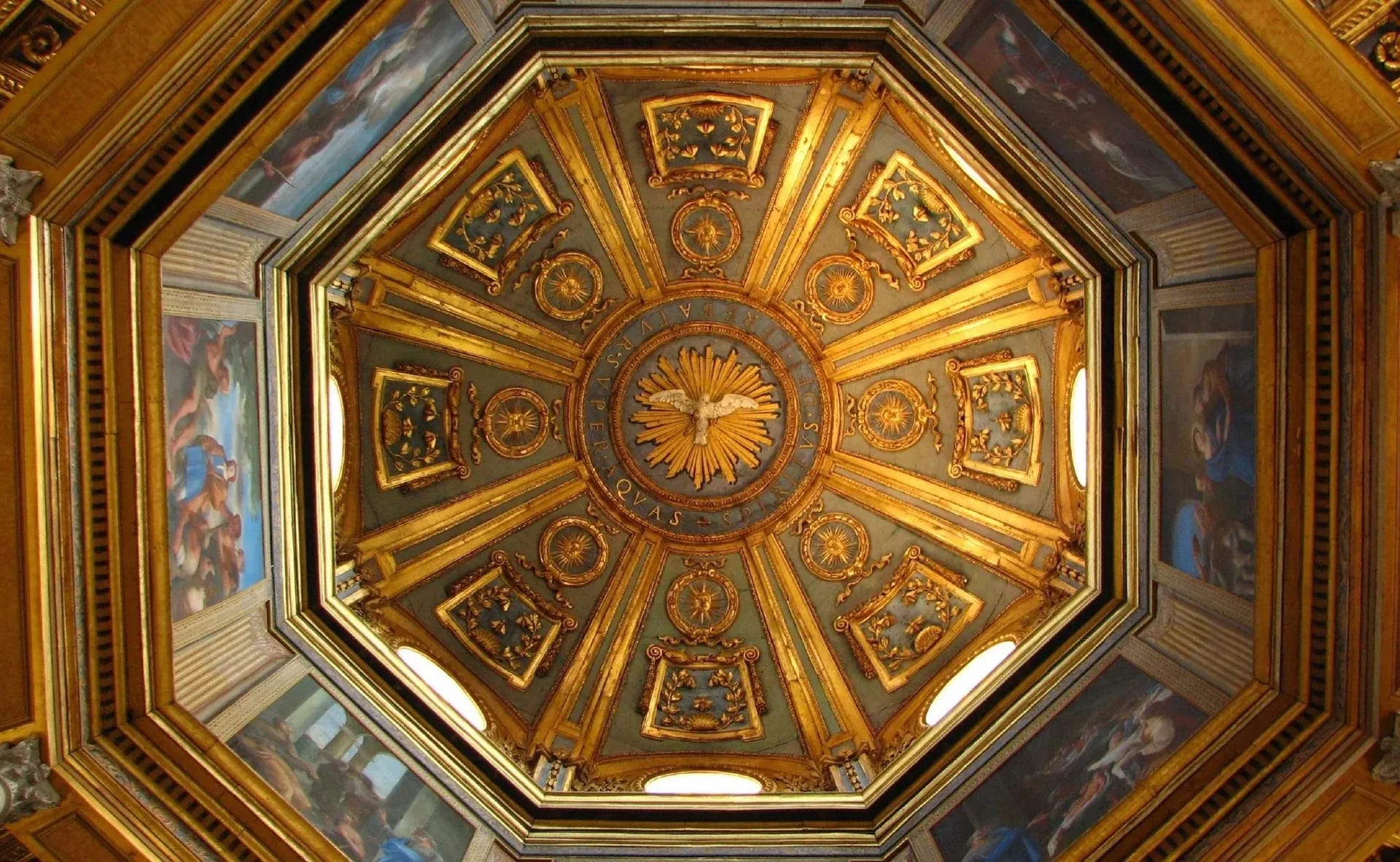
In my nonfiction books and my articles here I have used the word Ogdoadic to name a particular current: the Esoteric, Hermetic, Neoplatonic, Cabalistic, theurgic, sacramental Christian stream that runs, more or less through the history of the West. I want to explain why I have decided to mostly stop using that word — and what I intend to say instead.
Let me be clear about what I am not saying. I am not saying the current is a fiction. It is real, and it is recoverable. You can trace a coherent line of thought and practice from Byzantium down through the sacramental Christianity of the Latin West: a map of spiritual transformation drawn from patristic theology, Hermetic philosophy, and the ecstatic vision of the mystics. It was carried in writings, prayers, scholarship, architecture, and initiatory practice: in the octagonal baptismal fonts of Ambrose, which encode an eightfold theology of regeneration; in the celestial hierarchies of Dionysius, which supply a framework for theurgic ascent; in the Corpus Hermeticum preserved by Byzantine monks; in Pletho carrying that synthesis west to Florence; in Ficino fusing Hermetic praxis with Catholic sacramental theology. Real texts. Real practices. Real transformation, across many centuries.
What the stream never had was a single custodian.
There was no unified, intentional organization behind it. No College of Adepti quietly stewarding the current. No Golden Chain of custodians passing the torch from one generation to the next with a shared sense of mission and secret system of succession. The stream flowed where it flowed. Different people drank from it at different points, often without knowing one another, often without even knowing they were drinking from the same source. It is as if someone wandered a long time without a map, and only later, looking back at their own trail, saw that the path had a logic they could not see while they were walking it. We cannot retrofit intention onto that trail. But neither can we pretend the trail wasn’t there. The pattern is real even though no one was planning it.
So when we refer to “the Ogdoadic Tradition,” we should be honest about what kind of naming that is. It is not wrong, exactly, and it is certainly less of a mouthful than “the dispersed Esoteric, Hermetic, Neoplatonic, Cabalistic, theurgic, sacramental Christian tradition.” But it is a retroactive name. A description applied after the fact to a pattern that was not self-conscious while it was happening.
Where the word came from
The word itself, used in this sense, is not ancient. It was coined in the late 1970s and early 1980s by Melita Denning (Vivian Godfrey) across the five volumes of The Magical Philosophy, published by Llewellyn.
Here credit is due, and I want to give it clearly. Godfrey was a real scholar. She knew classical Neoplatonism, Byzantine Christianity, Renaissance Hermeticism, and the Kabbalah, and she knew them at a depth most occultists of her generation (and ours, frankly) could not touch. The philosophical framework that gives the “Ogdoadic” system its distinctive character (the emphasis on theurgic ascent, the engagement with Iamblichus and Proclus, the use of the Chaldean Oracles, the appeal to the line running through Pletho and the Florentine Academy) reflects learning that was earned. She understood these sources.
What she did with that learning is where I part company with the received account. She used it as the intellectual and aesthetic frame for a synthesis whose operative content came from elsewhere. The initiatory skeleton is clearly Martinist. The practical musculature is Golden Dawn. The cosmic theology appears to owe much to Crowley. And the whole body was then clothed in the garments of Neoplatonic philosophy and Hermetic history. The result is elegant. It hangs together. But it is a synthesis, not a transmission — whatever was claimed for it when the mythic backstory of her Ordo Aurum Solis was being assembled.
Her real contribution, and it is a real one, was to recognize the stream and give it a name. She saw that patristic baptismal theology, Dionysian hierarchy, Hermetic theurgy, and Renaissance Neoplatonism formed a coherent current, and she said so. Her error, whether deliberate or not, was to insist that someone had always been consciously managing it. That there was a Super Secret Society™ tending the stream. There wasn’t, and the stream didn’t need tending. It flowed on its own, through the cracks in institutional Christianity, through monastic libraries and philosophical academies and the private devotions of mystics who frequently did not know they had predecessors.
The modern trouble with the word
Two problems now attach to “Ogdoadic,” and they pull in opposite directions.
The first is that several modern bodies claim to work “the Ogdoadic tradition,” and at least two of them claim to be its sole heir — to hold the position that outside their particular Order the tradition cannot be reached at all. This is precisely the retrofitted intentionality I have just been describing, hardened into institutional property. You cannot own a stream. The claim to own it tells you something about the claimant and nothing about the water.
The second problem is simpler and more practical. Say “Ogdoadic” to most people and one of two things happens. Either they have never heard it, and you spend the next ten minutes defining it — again. Or they have heard it, in which case they know it only as the house term of the Aurum Solis, and you spend the next ten minutes distinguishing yourself from that — again. Either way the word costs you a paragraph before you’ve said anything.
Which lands us exactly where Godfrey started. If you would rather not carry the word — with its endless definition, its inter-Order politics, its quarrels over the One True Ogdoadic Way™ — then what, precisely, do you call the thing?
The answer was inside the word all along
Here is what I have come to. The Christian content of the Ogdoad was never really “the Eight” as a Neoplatonic numeral. It was the Eighth Day — the dies octava. The day beyond the seven days of creation. The day of Resurrection. The day on which the world is made new.
This is not my personal invention and it is not a stretch. It is why Ambrose’s fonts are octagons. Baptism is participation in the Eighth Day, regeneration into the world beyond the week; the earliest Christians built their baptisteries with eight sides to say so in stone. Justin, Basil, the Cappadocians, the whole patristic theology of the octave — that is the native historical Christian form of what Godfrey Hellenized into “Ogdoadic.” The Greek numeral names the surface. The Eighth Day names the depth.
And for those of us whose work is Martinist, the fit is closer still. The entire telos of Martinism, from Pasqually’s Traité de la Réintégration forward, is the fall of primordial man and his restoration to the divine state he lost. Réintégration is Eighth-Day theology. The Eighth Sphere beyond the Seven. The seven days are the fallen aeon; the Eighth is the cosmos restored, humanity returned to its origin and glorified past it. Pasqually’s operative drama and Basil’s octave are one eschatology in two idioms. When I say “the Eighth Day,” I am not swapping in a prettier term. I am naming the thing by its own theological heart instead of by a Greek label borrowed to dress it up.
So that is what I will say. Not because “Ogdoadic” is wrong, but because “Eighth-Day” is truer — and because it belongs to no one, which means no one can gatekeep it.
A word about what gets a capital letter
There is one more distinction here, and it is the one that actually dissolves the ownership quarrel, so I want to make it explicit.
The whole trouble with “the Ogdoadic Tradition” is that a single term was made to do two different jobs at once. It named a historical current, and it was a banner for modern work; collapsing those two into one word is exactly the sleight of hand I have been objecting to. It let a diffuse, unowned stream be spoken of as though it were a chartered Order with a custodial pedigree, which then licensed somebody to claim the charter.
I do not want to repeat that error in reverse. So I will keep the two acts of naming apart.
For the water itself, I will use a description, lowercase and unpretending: the sacramental-theurgic current, the Christian Hermetic stream — whatever the sentence needs. These are descriptions, not titles. Christian and Hermetic keep their capitals only because they were born of proper names; the stream itself is never enthroned as a Tradition or an Order. It takes no title, because, as I have said, it never needed tending and it has no custodian.
For a body that is actually, consciously being built, a proper name is appropriate, because a proper name belongs to a real and intentional thing. That is the one place the capital letter belongs.
Keep those separate and the “who holds the true Ogdoadic lineage” problem evaporates. No one can hold a lowercase description of where the water ran.
And the debt remains
None of this erases Denning and Phillips. It places them correctly. Their “Ogdoadic” writings — and Phillips’ later, explicitly Christian work on the “Ogdoadic mysteries of the Christian tradition” — are luminous modern witnesses to this stream. I read them with gratitude and I will keep citing them. What I decline is the further claim: that they, or the Order built on their books, are the door rather than a door. The stream is older, broader, and more generously diffused than any single modern body, however learned.
The light is not diminished by being recognized in more than one lamp.
So: what do I call it? I will refer to the current as the Eighth-Day stream, and honor the 20th and 21st century “Ogdoadic” writings as witnesses to it. I shall give the proper name to the work I am actually doing. And let the water keep running where it will — as it always has, with or without our permission.
Interesting. Christ rose on the figurative “eighth day”, the first day of a new era, and the octagon represents his resurrection. In Buddhism of course there is the noble eightfold path. But in Christianity it signifies the “double power” of the God-man, in whom the perfected man and divinity are united in the incarnation of Christ as Repairer, or Healer.